

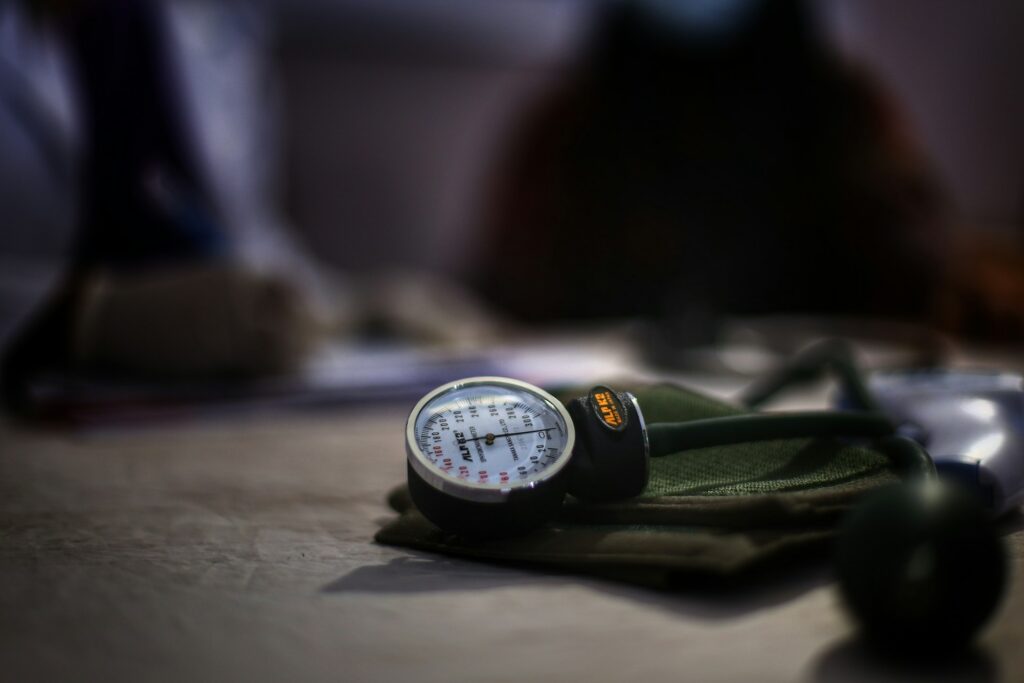
High blood pressure almost never announces itself. Alcohol is one of the few causes a person can actually change, though the first days after the last drink are the part most people are never warned about.
The reading comes back high at a routine appointment. The nurse takes it again on the other arm, writes down a second number, and then asks a question that sounds like it belongs to a different conversation: how much do you drink in a week? Nobody in the room says the word alcoholism. But something in the air changes, and the drive home down the Garden State Parkway is quieter than the drive over.
That moment happens in exam rooms across Union County and up through the Merrimack Valley every day, and it rarely lands on only one person. It lands on whoever the cuff was wrapped around, and on whoever has been quietly counting bottles for a year and finally has something on paper to point at. Blood pressure is one of the very few places where a drinking pattern shows up as hard data, printed on a slip of paper, before anything else in the body starts to fail.
The relationship between alcohol and blood pressure is better understood now than it was 10 years ago, and some of what used to be repeated as common knowledge has been quietly revised. The research also holds a second finding that matters enormously for anyone thinking about quitting: in the first days after heavy, sustained drinking stops, blood pressure does not fall. It climbs. That is the reason alcohol withdrawal is treated as a medical event rather than a test of willpower, and the reason alcohol detox is done with monitoring rather than alone in a spare bedroom.
The Number That Never Announces Itself
Blood pressure is written as two numbers separated by a slash, like 120/80 mm Hg. The National Heart, Lung, and Blood Institute defines the first number as systolic pressure, the force of blood against the artery walls at the moment the heart pumps, and the second as diastolic pressure, the lower pressure measured between beats while the heart is filling back up. A healthy systolic reading is under 120. A healthy diastolic reading is under 80.
Blood pressure counts as high when readings are consistently 130 or above on the top number, or 80 or above on the bottom number. NHLBI classifies 140 or higher systolic, or 90 or higher diastolic, as stage 2. A reading above 180 systolic or above 120 diastolic is a hypertensive crisis and is a reason to contact a provider immediately, not to wait until morning.
Half of all American adults have high blood pressure, and NHLBI notes that about 1 in 3 adults who have it do not know. Symptoms usually do not show up until the pressure has already caused serious damage, which is why the condition earned its reputation for being silent. There is no headache that reliably signals it, no chest tightness that shows up on schedule. Someone can feel completely ordinary while the arteries, kidneys, and heart carry a load they were not built to carry. The only way to know is to have it measured.
How Alcohol Moves the Number
Alcohol misuse can contribute to high blood pressure, irregular heartbeat, increased heart rate, and weakened heart muscle. NHLBI also identifies excessive alcohol use as a modifiable risk factor for hypertension.
Research shows the effect increases with alcohol consumption. A 2023 analysis of nearly 20,000 adults found that compared with no alcohol, 12 grams per day was associated with systolic blood pressure 1.25 mm Hg higher, while 48 grams was associated with a 4.90 mm Hg increase.
Another large meta-analysis found a similar pattern. Among men, hypertension risk increased by 19% at 1–2 drinks per day, 51% at 3–4 drinks, and 74% at 5 or more. Overall, the research points in the same direction: as alcohol consumption increases, so does blood pressure risk.
What Counts as One Drink in These Numbers
Grams of alcohol are not how anyone orders at a bar, so the conversion matters. In the United States, NIAAA defines one standard drink as about 14 grams of pure alcohol, which is a 12-ounce regular beer at 5 percent, a 5-ounce glass of table wine, or a 1.5-ounce shot of spirits. Those studies define a drink as 12 grams, so 12 grams a day is a little under one American standard drink, and 48 grams a day is roughly three and a half. Anyone pouring at home should also know that a generous glass of wine is often two standard drinks, and a craft beer at 10 percent is two drinks in one bottle. NIAAA notes that many people are surprised to learn what actually counts as a drink, and that is not dishonesty. It is arithmetic nobody taught them.
The “Good for Your Heart” Idea Has Been Revised
For about 30 years, the received wisdom was that light to moderate drinking protected the heart, usually illustrated with a glass of red wine. That claim was built on older population studies, and it has not held up as newer and larger analyses have come in. Repeating it now is out of step with what the current evidence actually says.
NIAAA’s own summary of alcohol’s effects on the body is direct about where the science stands: current research points to health risks even at low amounts of alcohol consumption, regardless of beverage type, and on cardiovascular risk specifically, even low drinking levels may confer risk. The 2018 meta-analysis in the Journal of the American Heart Association reached the same conclusion from the other end, stating that its authors found no evidence for a protective effect of alcohol consumption in women, contrary to earlier meta-analyses. The 2023 dose-response analysis found no lower threshold for systolic pressure at all, meaning there was no light-drinking zone where the effect reversed and pressure came out lower, which is what a protective benefit would have looked like.
None of this is a reason for shame about a glass of wine at a wedding. It matters for a much more practical reason. Anyone weighing whether their drinking is worth reconsidering deserves current information rather than a comfortable line from a decade-old magazine article, and anyone managing blood pressure with medication deserves to know that alcohol is working against the prescription rather than alongside it. For a person with alcohol use disorder, the cardiovascular strain is one more part of the illness that treatment can actually address.
What Happens to Blood Pressure When Someone Stops Drinking
The long-term effects of stopping alcohol can be beneficial for blood pressure, but the first few days may be dangerous for people who have been drinking heavily. Alcohol withdrawal can cause autonomic hyperactivity, leading to increased blood pressure, rapid heart rate, tremors, sweating, insomnia, agitation, and seizures. Symptoms may begin within hours and often peak around 72 hours.
Stopping alcohol abruptly after heavy, sustained drinking can be medically dangerous. Severe withdrawal can progress to delirium tremens (DTs), which may involve confusion, hallucinations, fever, rapid heart rate, and dangerously elevated blood pressure. Repeated withdrawals can also become more severe, a phenomenon known as kindling. This is why alcohol withdrawal may require medical supervision rather than attempting to quit at home.
Over the longer term, reducing alcohol consumption can improve blood pressure. A large meta-analysis found the greatest benefit among people consuming six or more drinks per day who reduced their intake by about half: systolic blood pressure decreased by an average of 5.50 mm Hg, while diastolic pressure fell by 3.97 mm Hg.
What Medically Supervised Withdrawal Management Actually Does
Withdrawal management is medically supervised detox designed to keep the nervous system stable while alcohol leaves the body. At Serenity at Summit, ASAM Level 3.7 medically monitored inpatient detox includes 24/7 nursing and close monitoring for complications.
Care may include CIWA-Ar assessments to track withdrawal severity, symptom-triggered medications to reduce seizure and delirium risk, cardiac monitoring for higher-risk patients, IV fluids and electrolytes, thiamine, and medications for symptoms such as nausea, insomnia, and agitation.
Medical oversight is especially important for people with high blood pressure or other health conditions because alcohol, withdrawal, and prescription medications can affect the cardiovascular system simultaneously. Learn more about the risks of detoxing without medical supervision, treatment with existing health conditions, and alcohol tapering. The strain withdrawal places on the heart and circulatory system is another reason medical monitoring can be important.
Where This Fits at Serenity at Summit
Most people who call about alcohol are not calling about their blood pressure. They call because something finally stacked up high enough, and often the reading was the last thing on the stack.
Serenity at Summit provides medical detox and residential treatment for substance use disorders at two locations. The Union, New Jersey campus sits in Union County, within reach of Newark, Elizabeth, and the wider New York City metro by way of the Garden State Parkway and the New Jersey Turnpike. The Haverhill, Massachusetts campus serves Essex County and the Merrimack Valley, drawing from Lawrence, Lowell, Methuen, the southern New Hampshire border towns, and greater Boston along I-495 and I-93.
Clearing alcohol from the body is the first few days, not the whole answer, and it would be dishonest to present it as the finish line. Medically monitored detox stabilizes the acute phase, and residential treatment is where the harder work of staying stopped begins, in a setting where the pressure and the triggers of ordinary life are turned down long enough to build something new. Because heavy drinking so often sits on top of depression, anxiety, or trauma, care here addresses co-occurring mental health conditions with dual diagnosis treatment, rather than treating the alcohol in isolation. Where it fits clinically, medication for alcohol use disorder such as naltrexone can be part of the plan, though whether any medication is appropriate is an individual decision made with a physician.
Serenity at Summit works with a range of insurance plans, and the admissions team can walk through what a specific policy actually covers before anyone commits to anything. That conversation can start through insurance verification without a decision attached to it.
Start Alcohol Detox Safely at Serenity at Summit
If a blood pressure reading is what brought you this far, that is a better reason to start than most people ever give themselves. The number on the slip may be yours, or it may belong to the person whose drinking you have been carrying around in your head for a year.
Either way, the first conversation with our admissions team is about facts: what a particular drinking pattern means for withdrawal risk, what a medically monitored stay involves day to day, and what a plan covers, said in plain language. You can begin that through our admissions page, and nothing in that first call commits anyone to a bed. If today turns out not to be the day, come back to it. We will pick the conversation up wherever you left it.
Frequently Asked Questions About Alcohol and Blood Pressure
Both effects are real, and they are different. Alcohol raises blood pressure acutely in the hours around drinking, and sustained drinking is associated with lasting elevation. In a 2023 pooled analysis of seven cohort studies following 19,548 adults, the association between how much people drank and where their blood pressure sat years later was substantially linear, with roughly 1.25 mm Hg higher systolic pressure at 12 grams of alcohol per day and 4.90 mm Hg higher at 48 grams. Once readings stay at 130 or above systolic, or 80 or above diastolic, it is a diagnosis rather than a passing effect and should be evaluated by a clinician.
For heavier drinkers, the research says yes, though not immediately. A 2017 meta-analysis of 36 trials found the effect was dose-dependent: people drinking 2 or fewer drinks a day saw no meaningful change from cutting back, while people drinking 6 or more a day who reduced their intake by about half saw systolic pressure fall by roughly 5.5 mm Hg and diastolic by about 4 mm Hg. Expect the opposite direction first. In the initial days after heavy drinking stops, withdrawal typically drives blood pressure and heart rate up, which is why that window is one to get through with medical supervision rather than alone.
Talk to a clinician before stopping, and treat that as the actual first step rather than a formality. Existing hypertension, heart conditions, an older age, a history of previous withdrawals, and daily heavy drinking all raise the risk that withdrawal becomes an emergency instead of a rough week. A medically monitored setting handles that with vital sign monitoring, CIWA-Ar scoring, a symptom-triggered medication taper, and cardiac monitoring where it is warranted. Serenity at Summit provides ASAM Level 3.7 medically monitored detox in Union, New Jersey and Haverhill, Massachusetts, and the admissions team can review a specific medical history and insurance plan before anyone travels anywhere.
Sources
- National Heart, Lung, and Blood Institute. (2024). High blood pressure. Retrieved from: https://www.nhlbi.nih.gov/health/high-blood-pressure. Accessed on August 19, 2026.
- National Heart, Lung, and Blood Institute. (n.d.). High blood pressure: Causes and risk factors. Retrieved from: https://www.nhlbi.nih.gov/health/high-blood-pressure/causes. Accessed on August 19, 2026.
- National Institute on Alcohol Abuse and Alcoholism. (n.d.). Alcohol’s effects on the body. Retrieved from: https://www.niaaa.nih.gov/alcohols-effects-health/alcohols-effects-body. Accessed on August 19, 2026.
- National Institute on Alcohol Abuse and Alcoholism. (n.d.). What is a standard drink? Retrieved from: https://www.niaaa.nih.gov/alcohols-effects-health/what-standard-drink. Accessed on August 19, 2026.
- Di Federico, S., Filippini, T., Whelton, P. K., Cecchini, M., Iamandii, I., Boriani, G., & Vinceti, M. (2023). Alcohol intake and blood pressure levels: A dose-response meta-analysis of nonexperimental cohort studies. Hypertension, 80(10), 1961–1969. Retrieved from: https://pmc.ncbi.nlm.nih.gov/articles/PMC10510850/. Accessed on August 19, 2026.
- Roerecke, M., Tobe, S. W., Kaczorowski, J., Bacon, S. L., Vafaei, A., Hasan, O. S. M., Krishnan, R. J., Raifu, A. O., & Rehm, J. (2018). Sex-specific associations between alcohol consumption and incidence of hypertension: A systematic review and meta-analysis of cohort studies. Journal of the American Heart Association, 7(13), e008202. Retrieved from: https://pmc.ncbi.nlm.nih.gov/articles/PMC6064910/. Accessed on August 19, 2026.
- Roerecke, M., Kaczorowski, J., Tobe, S. W., Gmel, G., Hasan, O. S. M., & Rehm, J. (2017). The effect of a reduction in alcohol consumption on blood pressure: A systematic review and meta-analysis. The Lancet Public Health, 2(2), e108–e120. Retrieved from: https://pmc.ncbi.nlm.nih.gov/articles/PMC6118407/. Accessed on August 19, 2026.
- Canver, B. R., Newman, R. K., & Gomez, A. E. (2024). Alcohol withdrawal syndrome. StatPearls. Retrieved from: https://www.ncbi.nlm.nih.gov/books/NBK441882/. Accessed on August 19, 2026.
- New Jersey Department of Human Services, Division of Mental Health and Addiction Services. (n.d.). Division of Mental Health and Addiction Services. Retrieved from: https://www.nj.gov/humanservices/dmhas/. Accessed on August 19, 2026.
